
ProShares Ultra Ether ETF (ETHT, NYSE)
- Feb 10
- 7 min read
Manhattan Crypto Capital Quant Research v1.0

ProShares Ultra Ether ETF (ETHT, NYSE)
3 min read
Asset Type: 2x Leveraged Ethereum ETF (Crypto Proxy)
Sector: Digital Assets / Financial Products
Industry: Leveraged Crypto ETFs
Chart Timeframe: 7D (Weekly)
Current Price (Chart): ~15.0 (near upper buy band)
Vehicle Role: Tactical Levered
Fund Mandate: Asymmetric Leverage
Issue: December 19, 2025
1. Asset Overview
ProShares Ultra Ether ETF (ETHT) is a 2x leveraged exchange-traded fund designed to deliver approximately twice the daily performance of an Ethereum benchmark. It offers magnified exposure to Ethereum price moves without direct on-chain custody, making it a structurally short- to medium-term trading vehicle rather than a long-term compounding instrument.
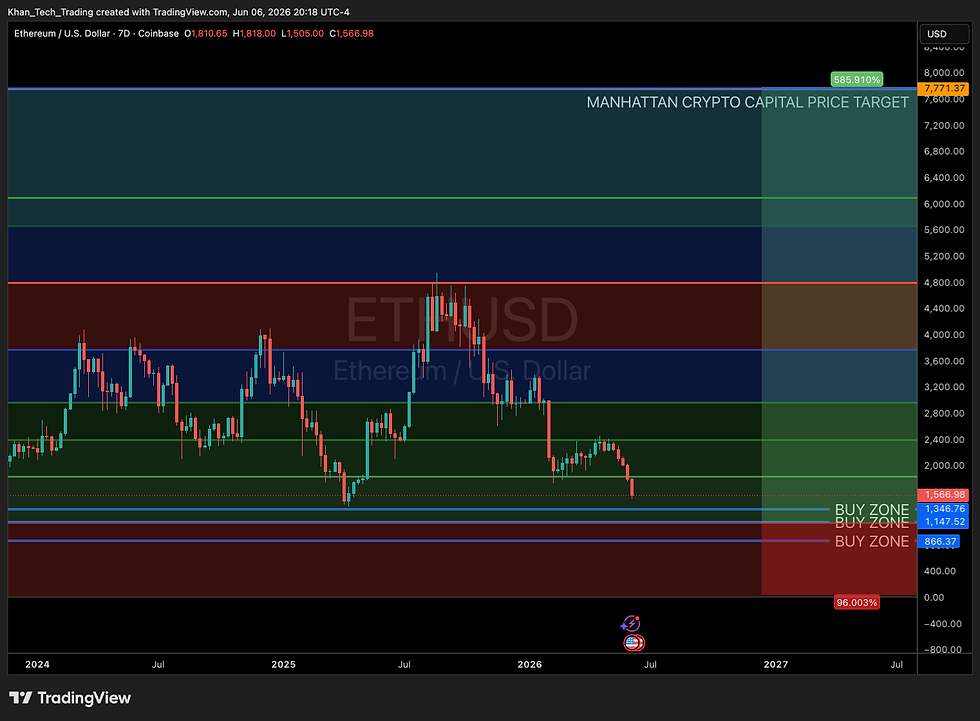
The chart shows a completed topping structure after a strong parabolic advance, followed by a persistent downside trend with successive lower highs and lower lows. Price is now approaching prior structural demand and horizontal levels that previously acted as breakout zones.
Within the Manhattan Crypto Capital framework, ETHT is a pure tactical asymmetric instrument used selectively to amplify high-conviction Ethereum inflection points, never as a core holding or primary crypto exposure.
2. Market Regime & Quant Score
Market Regime: Correction → Late-Stage De-Risking
Total Quant Regime Score: 39 / 100
Fear / Greed Quant State:
State: Deep Fear
Justification: Persistent sequence of large red candles, breakdown from prior consolidation shelf, trade well below trendline, and lack of meaningful upside follow-through on bounce attempts.
Interpretation:
The prior expansion regime has fully unwound. ETHT is in a late-stage corrective regime with elevated realized volatility and aggressive de-leveraging. However, price is starting to approach structurally important historical demand zones. Asymmetry improves materially only if and when the downside momentum begins to decelerate around those levels and Ethereum itself transitions back toward neutral-to-risk-on conditions.
3. Manhattan Crypto Capital Portfolio Context
Engine Role: Tactical Leverage Engine (Crypto Sleeve)
Function: High-octane overlay on top of core spot/ETF Ethereum exposure; not a substitute for underlying ETH or core crypto positions.
Volatility Behavior:
Extreme; daily swings are typically 2x the underlying ETH volatility.
Sharp whipsaws around macro events (rates, regulation, risk-on/off rotations).
Cross-Asset Interactions:
Crowds in/out capital versus:
Core crypto (spot ETH, unlevered ETFs).
Risk-on equity growth sleeve.
Capital exiting ETHT is typically rotated into:
Core Ethereum/crypto at lower leverage.
Gold / defensive hedges during stress.
Private credit / yield when harvesting gains.
Capital Rotation Logic:
Yield / core crypto profits → ETHT (only at defined cycle inflection points).
ETHT gains → Recycled back into core ETH, gold, and private credit.
No “parking” capital here; this is a cyclical levered overlay only.
4. Fundamental Analysis
Category | Key Points | Score (0–100) |
Business Quality | Pass-through 2x exposure to Ethereum; no operating business; structurally path-dependent NAV. | 32 |
Financial Strength | Backed by derivatives and collateral; counterparty/derivative and rebalancing risk present. | 40 |
Earnings & Margins | No earnings; performance driven by underlying ETH and leverage mechanics. | 25 |
Growth Outlook | Upside fully tied to ETH adoption, cycle, and volatility; reflexive but highly cyclical. | 48 |
Valuation Snapshot | No intrinsic valuation; vehicle value = leveraged mark-to-market of ETH path. | 38 |
Fundamental Composite | Average structural profile for a leveraged crypto ETF; unsuitable for long-duration holds. | 37 |
5. Intrinsic Value & Fair Value
ETHT has no traditional intrinsic value—its “fair value” is entirely derived from the leveraged performance of Ethereum and the mechanics of daily rebalancing. Over long horizons, volatility decay and path dependency typically erode value, even in bullish cycles.
At current levels near ~15, pricing reflects a substantial drawdown from prior highs and a market that is deeply risk-off toward leverage. The margin of safety is only meaningful if accumulated after sharp liquidations and in conjunction with evidence of cycle stabilization in ETH itself.
6. Technical Analysis
Trend Status:
Clearly below prior ascending trendline.
Series of lower highs and lower lows; dominant downtrend persists.
Regime:
Post-parabolic breakdown and ongoing distribution/correction.
Momentum & Structure:
Strong downside candles with limited upside follow-through.
Oversold conditions are building, but there is not yet a confirmed reversal structure.
Bias Change Triggers:
First: Weekly stabilization and basing above ~15.08–12.59 with reduced volatility and higher lows.
Stronger: Break and hold back above the prior mid-range congestion and a sustained improvement in ETH spot price structure.
7. Key Price Levels
Tag | Level (Price) | Action / Role | Notes |
Manhattan Crypto Capital Price Target (T1) | 91.41 | Primary take-profit / rotation level | Anchored to chart target zone marked as “Manhattan Crypto Capital Price Target”. |
15.08 | Shallow DCA entry | First demand band near current region; tactical rebid zone. | |
12.59 | Intermediate DCA entry | Deeper support; prior structural pivot congestion. | |
6.77 | Deep cycle-stress entry | High-stress capitulation zone; only for disciplined capital. | |
1.68 | Tail-risk capitulation entry | Extreme scenario; represents structural washout in ETH. |
8. BUY Scenario – Structured Accumulation (No FOMO)
Manhattan Crypto Capital treats ETHT as a strictly rule-based tactical position. Accumulation is only considered after major liquidations and exclusively at chart-defined levels.
Core Logic:
Buy into fear at pre-defined levels only; never chase strength.
Use DCA tiers to improve average cost and capture asymmetric upside if/when ETH recovers.
Buy Level Framework:
15.08 – Shallow corrective demand near current region; appropriate for initial, small tactical exposure.
12.59 – Higher-conviction DCA level with better asymmetry; ideal for building core tactical size.
6.77 – Deep stress buy; only executed if ETH enters aggressive risk-off phase.
1.68 – Extreme capitulation; reserved for a small final tranche if crypto broadly capitulates.
Acquisition Quality (0–100):
15.08 → 62
12.59 → 74
6.77 → 86
1.68 → 92
Example Staged Allocation (Total $1,000)
Shallow (Worst Case scenario path): $1,000 at 15.08 (if only first level is tagged).
Base Case path: $600 at 15.08, $400 at 12.59 (if both upper levels are filled).
Best Case path: $350 at 15.08, $300 at 12.59, $200 at 6.77, $150 at 1.68 (if all four levels are tagged).
9. Scenario Engine – Allocation by Buy Level
Price Level | Worst Case Allocation | Base Case Allocation | Best Case Allocation |
15.08 | $1,000 (100%) | $600 (60%) | $350 (35%) |
12.59 | $0 | $400 (40%) | $300 (30%) |
6.77 | $0 | $0 | $200 (20%) |
1.68 | $0 | $0 | $150 (15%) |
Total | $1,000 | $1,000 | $1,000 |
10. SELL / RISK-OFF Scenario
Primary Exit:
Full exit at T1 = 91.41, rotating proceeds back into core Ethereum exposure, gold/hedges, and private credit yield.
Interim Risk Management (if a tradable squeeze appears before T1):
Partial trims can be considered on sharp spikes and failed retests of prior structural resistance zones, but the core framework assumes a full rotation at T1.
Invalidation:
Structural invalidation occurs on a prolonged breakdown and weekly close at or below 1.68 without signs of ETH-cycle stabilization or macro risk-on recovery.
11. Risk Profile
Volatility Classification: Extreme
Historical/Projected Drawdown Risk: 70–90%+ drawdowns possible in severe crypto bear legs, especially given 2x leverage and compounding decay.
Trend Strength: Currently strong to the downside; would only moderate after several weeks of basing and reduced range.
Probability-Weighted Success Range: Approximately 40–55% for reaching T1 over a full crypto cycle if entries are constrained to the defined buy levels and risk management is honored.
Total Risk Score: 24 / 100 (lower score = higher risk)
Tail Risks:
Regulatory shocks to crypto markets.
Extended crypto winter with suppressed ETH volatility and direction.
Volatility decay significantly reducing ETF value despite ETH eventually recovering.
Derivatives or tracking dislocation risk in extreme stress events.
12. Fundamental / Structural Health Check
ETHT is structurally not a long-term wealth-compounding instrument. The daily rebalancing and leveraged exposure make it vulnerable to volatility decay, especially in sideways or choppy bear markets. The health of the vehicle is entirely contingent on:
Liquidity and integrity of Ethereum derivatives markets.
Regulatory environment for leveraged crypto products.
Operational robustness of the fund sponsor and custodial relationships.
From a structural standpoint, ETHT is acceptable only as a short- to medium-horizon tactical vehicle aligned with Ethereum’s major cycle turns.
13. Quantitative Scoring Framework
Component | Score |
Business Quality | 32 |
Financial Strength | 40 |
Earnings & Margins | 25 |
Growth Outlook | 48 |
Valuation Discipline | 40 |
Fundamental Composite | 37 |
Technical Structure | 41 |
Total Quant Score | 39 |
14. Risk-On / Risk-Off Composite
Risk-On Score: 34
Risk-Off Score: 66
Interpretation:
Manhattan Crypto Capital remains predominantly risk-off with respect to leveraged Ethereum exposure. Capital deployment into ETHT is reserved for periods when price tags the defined buy levels and there is corroborating evidence of ETH-cycle stabilization.
15. Investment Entry, Exit & ROI Scenarios (Table – $1,000 Notional)
Assumptions:
T1 (Manhattan Crypto Capital Price Target) = 91.41.
Notional capital = $1,000 per scenario.
Average entries derived from allocations in Section 9.
ROI figures are approximate and rounded.
Scenario | Entry Coverage | Assumed Avg Entry | Target (T1) | Probability | $ Gain at T1 (≈) | ROI % at T1 (≈) | Notes |
Worst Case | Only 15.08 filled | 15.08 | 91.41 | 30% | ~$5,060 | ~506% | Shallow correction only; no deeper fills. |
Base Case | 15.08 and 12.59 filled | ~14.08 | 91.41 | 45% | ~$5,490 | ~549% | Healthier DCA; more attractive asymmetry. |
Best Case | 15.08, 12.59, 6.77, 1.68 all filled | ~10.66 | 91.41 | 25% | ~$7,570 | ~757% | Full capitulation then full-cycle recovery. |
15A. Scenario Outcome Interpretation
Scenario | IF (Validation Condition) | THEN (Action) | OR (Invalidation / Risk Response) |
Worst Case | IF price tags 15.08, holds that level on a weekly closing basis, and ETH stabilizes with higher lows on daily charts | THEN maintain full $1,000 position targeting 91.41 (T1) | OR reduce/exit early if price loses 15.08 with expanding downside momentum and weak ETH tape. |
Base Case | IF both 15.08 and 12.59 are filled and weekly closes hold above 12.59 | THEN treat as primary DCA path; continue to hold for T1 while monitoring ETH regime | OR cut exposure back toward worst-case size if price repeatedly rejects 12.59 from below. |
Best Case | IF 15.08, 12.59, 6.77, and 1.68 are all filled and ETH transitions from deep fear to risk-on (higher highs on multi-week basis) | THEN hold full allocation for targeted full-cycle recovery toward 91.41 | OR invalidate best case and de-risk materially on a sustained weekly close below 1.68. |
16. Strategic Interpretation (Manhattan Crypto Capital Risk Mandate)
ETHT is treated as a high-octane tactical overlay. Manhattan Crypto Capital will only deploy capital into ETHT within the pre-specified buy levels and never as a core Ethereum allocation. Capital is allocated gradually as fear intensifies and is systematically harvested into T1, with proceeds rotated back into core crypto, gold, and private credit. Risk management prioritizes strict adherence to the buy-zone framework and rapid de-leveraging upon structural breaks.
17. Investment Synthesis
ETHT offers extremely high upside asymmetry from current and lower zones but at the cost of equally extreme path and decay risk. For investors with disciplined risk management, defined time horizons, and a strong understanding of Ethereum’s cycle dynamics, ETHT can serve as a powerful but dangerous instrument to amplify conviction views. It is inappropriate for conservative capital, long-term passive investors, or anyone unable to tolerate deep interim drawdowns and potential permanent capital impairment if the crypto cycle fails to reflate.
18. One-Liner (Institutional Summary)
ETHT is a high-risk, high-torque Ethereum overlay best deployed only at predefined capitulation levels, with Manhattan Crypto Capital targeting a full-cycle mean reversion toward 91.41 and strict rotation back into core assets upon success.
⚠️ LEGAL DISCLAIMER
This content is quantitative research and technical analysis for educational purposes only and does not constitute financial advice, investment recommendations, or solicitation to trade. Investing in securities involves risk, including potential loss of capital. Past performance does not guarantee future results. Always conduct your own research and consult a licensed financial professional before making investment decisions.
Comments