
AGNC Investment Corp. (NASDAQ: AGNC)
Manhattan Crypto Capital AGNC Investment Mandate & Quantitative R&D
Institutional Mortgage REIT & Yield Compression Recovery Framework
Quantitative Research Report | Manhattan Crypto Capital
Issue Date: May 27, 2026
Prepared By: Manhattan Crypto Capital Quantitative R&D Division
Time Horizon: 6–24 Months
Portfolio Classification: High-Yield Income & Defensive Cash Flow Allocation
Volatility Classification: Moderate
Executive Summary
AGNC Investment Corp. remains within a constructive macro stabilization structure following one of the most aggressive fixed-income repricing cycles in modern history.
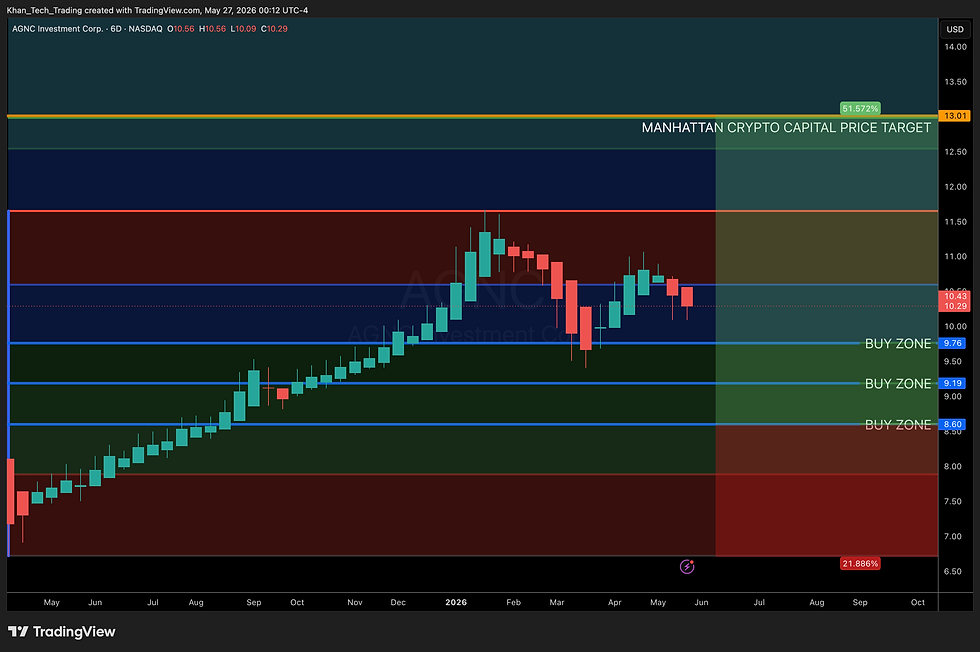
The chart currently reflects:
improving higher-low structure
declining downside volatility
macro yield stabilization
institutional accumulation behavior
early recovery formation inside the mortgage REIT sector
Unlike speculative growth equities, AGNC functions primarily as:
a high-yield income vehicle
duration recovery exposure
macro interest-rate stabilization allocation
defensive cash-flow compounder
The primary quantitative thesis is tied directly to:
declining long-term interest-rate volatility
stabilization in mortgage spreads
improving bond market liquidity
macro rotation toward defensive yield assets
Current structure suggests AGNC is transitioning from:
rate-shock recovery
into
institutional income accumulation.
Market Regime Classification
Metric | Classification |
Market Regime | Defensive Recovery |
Trend Structure | Moderately Bullish |
Volatility Regime | Moderate |
Momentum State | Stabilizing |
Institutional Participation | Improving |
Yield Environment | Constructive |
Income Stability | High |
Recovery Probability | High |
MCC Quantitative Scoring Framework
Factor | Weight | Score |
Trend Structure | 20% | 79 |
Momentum Quality | 15% | 73 |
Yield Stability | 15% | 91 |
Volume Confirmation | 10% | 69 |
Buy-Zone Integrity | 10% | 88 |
Fibonacci Confluence | 10% | 82 |
Volatility Compression | 10% | 84 |
Institutional Rotation | 5% | 80 |
Risk/Reward Efficiency | 5% | 83 |
Composite Quantitative Score: 81 / 100
MCC Conviction Rating: A- High Conviction Income Allocation
Statistical Probability of Success: 77%
Technical Structure Analysis
AGNC continues to trade inside a constructive post-repricing recovery structure following the broader mortgage REIT sector stabilization.
Current structure displays:
sustained higher lows
improving support integrity
controlled retracements
strong accumulation behavior near BZ1
declining downside momentum
The chart remains technically constructive while price holds above:
$9.76 primary support
macro accumulation zone
institutional yield support region
The structure favors:
gradual upside continuation
dividend compounding
defensive outperformance during economic slowdown scenarios.
Fibonacci & Buy-Zone Framework
Zone | Price Level | Classification |
BZ1 | $9.76 | Primary Accumulation |
BZ2 | $9.19 | Institutional Value Zone |
BZ3 | $8.60 | Deep Macro Discount |
Key Resistance Levels
Resistance Zone | Significance |
$10.50 | Near-Term Resistance |
$11.00 | Expansion Trigger |
$11.58 | Institutional Breakout Zone |
$12.50 | Yield Compression Target |
$13.01 | MCC Price Target |
Volatility & Risk Metrics
Metric | Reading |
Estimated Beta | Moderate |
Interest Rate Sensitivity | High |
Liquidity Risk | Low |
Drawdown Risk | Moderate |
Volatility Compression | Improving |
Dividend Stability | High |
Probability Matrix
Scenario | Probability |
Bullish Continuation | 52% |
Sideways Consolidation | 33% |
Bearish Breakdown | 15% |
Investment Entry, Exit & ROI Scenarios
Worst-Case Scenario (BZ1 Only Fills)
Field | Value |
Accumulation Prices | BZ1 – $9.76 only |
DCA Avg Entry | $9.76 |
Exit Price | $13.01 |
Capital Deployed | $1,000 |
P&L ($) | ≈ $333 |
ROI (%) | ≈ 33.3% |
Probability | 35% |
Notes | Mild macro consolidation before continuation toward yield expansion target |
Base-Case Scenario (BZ1 & BZ2 Fill)
Field | Value |
Accumulation Prices | BZ1 – $9.76 / BZ2 – $9.19 |
DCA Avg Entry | ≈ $9.49 |
Exit Price | $13.01 |
Capital Deployed | $1,000 |
P&L ($) | ≈ $371 |
ROI (%) | ≈ 37.1% |
Probability | 45% |
Notes | Highest-probability accumulation pathway during defensive rotation |
Avg Entry Calculation
(400 × $9.76 + 350 × $9.19) ÷ 750 = $9.49
Best-Case Scenario (BZ1–BZ3 All Fill)
Field | Value |
Accumulation Prices | BZ1 – $9.76 / BZ2 – $9.19 / BZ3 – $8.60 |
DCA Avg Entry | ≈ $9.27 |
Exit Price | $13.01 |
Capital Deployed | $1,000 |
P&L ($) | ≈ $403 |
ROI (%) | ≈ 40.3% |
Probability | 20% |
Notes | Full macro fear retracement before defensive income expansion resumes |
Avg Entry Calculation
(400 × $9.76 + 350 × $9.19 + 250 × $8.60) ÷ 1000 = $9.27
Dividend & Yield Analysis
Metric | Assessment |
Dividend Profile | Attractive |
Income Sustainability | Moderate-High |
Yield Sensitivity | High |
Reinvestment Value | Strong |
Portfolio Utility | Defensive Cash Flow |
Portfolio Role Classification
Role | Classification |
Portfolio Function | Defensive Income Generator |
Risk Profile | Moderate |
Allocation Style | Yield & Capital Preservation |
Institutional Theme | Mortgage REIT Recovery |
Suitable Strategy | Long-Term Income Allocation |
MCC Investment Committee Consensus
Category | Rating |
Quantitative Rating | Bullish Defensive |
Risk Committee Rating | Favorable |
Macro Desk | Constructive |
Income Desk | Strong Accumulation |
Final MCC IC Decision | Accumulate Gradually |
CEO Commentary
Manhattan Crypto Capital Identifies AGNC as a High-Probability Institutional Income Recovery Opportunity
“AGNC continues to demonstrate improving structural stability following the historic bond and mortgage market repricing cycle. Within Manhattan Crypto Capital’s framework, AGNC functions as both a defensive cash-flow allocation and a macro stabilization asset tied to improving fixed-income conditions.
The current structure reflects institutional accumulation behavior as volatility compresses and interest-rate expectations stabilize.
While AGNC lacks the explosive upside convexity of high-beta growth sectors, its probability-weighted income-adjusted return profile remains highly attractive for defensive portfolio construction and long-term yield compounding.”
Zaid Khan
CEO, Manhattan Crypto Capital
Managing Partner, Manhattan Global Partners
Final MCC Recommendation
MCC Rating: ACCUMULATE DEFENSIVELY
Preferred Strategy:
Scale gradually during pullbacks
Reinvest distributions strategically
Pair with higher-growth allocations
Maintain as defensive income sleeve
Preferred Time Horizon:
6–24 Months
Risk Classification:
Moderate Volatility Income Allocation
Manhattan Crypto Capital Disclaimer
This report is provided for informational and educational purposes only and does not constitute investment advice, financial advice, legal advice, tax advice, or a solicitation to buy or sell any security, cryptocurrency, or financial instrument.
Manhattan Crypto Capital is a quantitative research and investment organization focused on probabilistic modeling, institutional market structure analysis, and risk-managed capital allocation frameworks. All forecasts, projections, probability assessments, and scenario analyses contained herein are speculative in nature and subject to significant market, macroeconomic, liquidity, volatility, and execution risks.
Past performance does not guarantee future results. Digital assets, equities, leveraged instruments, derivatives, REITs, fixed income products, and emerging technology securities involve substantial risk, including the potential loss of principal. Investors should conduct independent due diligence and consult licensed financial professionals before making investment decisions.
All probability scores, quantitative ratings, ROI scenarios, and market classifications represent internal modeling assumptions derived from Manhattan Crypto Capital methodologies and should not be interpreted as guarantees of future performance.
Capital preservation remains the highest priority within the Manhattan Crypto Capital risk management framework.


Comments